

What If the Water Heater Leaked While I Was Away?
Delayed-discovery losses deserve closer evaluation because building materials may have remained wet for days. Hidden moisture, material deterioration and microbial growth become more important considerations.
Can Furniture and Contents Be Saved?
Often, depending on the water source, material and duration. Move salvageable contents out of standing water when safe and document them before disposal.
Should I Call My Insurance Company?
For a potentially covered loss, document the condition and notify the carrier according to the policy. Do not intentionally allow wet materials to remain damaged while waiting for an adjuster.
Does Homeowners Insurance Cover a Water-Heater Leak?
Sometimes. Sudden accidental water discharge can be treated differently from long-term leakage, deterioration or maintenance. The policy and cause determine coverage.
Should I Wait for the Adjuster Before Extraction?
Generally no when water is actively damaging the building. Preserve photographs and records, notify the carrier as appropriate and take reasonable action to prevent additional damage.
Can I Claim Extra Electricity From Drying Equipment?
For an insurance loss, keep the bill covering the drying period and approximately three months of prior utility bills as a baseline. The documented increase can be submitted as a supplemental expense, subject to carrier review.
What Should the Restoration Company Document?
Useful documentation includes the source, affected rooms, photographs, moisture readings, extraction, equipment placement, daily monitoring, necessary demolition and final dry readings.
What If the Water Heater Tank Ruptured Completely?
A ruptured tank can release a large volume quickly. After safety and source control, professional extraction should begin as soon as practical and the moisture path should be mapped beyond the visibly flooded room.
What If Only a Water-Heater Supply Line Failed?
A failed connector or supply line can still release substantial water. Repairing the line stops the source, but wet building materials still need evaluation and drying.
Who Do I Call After a Water Heater Floods My Home?
Call a plumber for the failed heater or plumbing connection and a professional water-damage restoration company for the escaped water and structural drying.
What Should I Do First When My Water Heater Floods the House?
Think safety first. If it can be done safely, shut off the water supply to the heater or the home's main water supply. Shut down the appropriate energy source only when you know how to do so safely. Stay clear of standing water around energized electrical equipment.
Who Do I Call – a Plumber or Water-Damage Company?
Usually both. A plumber repairs or replaces the failed water heater or plumbing connection. A water-damage restoration company extracts the escaped water, maps hidden moisture and dries the building.
Should I Turn Off the Water Heater?
If it is safe and you understand the equipment, isolate the water and energy source. Gas and electric water heaters have different hazards. When uncertain, do not improvise around standing water, electricity or gas – call the appropriate professional.
Should I Shut Off the Main Water Supply?
If water is still flowing and the local shutoff is not working or accessible, shutting off the home's main water supply can limit additional damage when it can be done safely.
What If the Water Heater Is in the Garage?
Garage losses can still migrate into interior walls, bedrooms, closets and flooring through door thresholds, wall plates and adjoining assemblies. Do not assume the damage stops at the garage because that is where the heater sits.
What If the Water Heater Is Upstairs?
An upstairs water-heater failure can affect multiple levels. Water can move through flooring, ceilings, insulation, walls, light fixtures and framing before it becomes visible below.
How Far Can Water From a Water Heater Travel?
Potentially much farther than the visible puddle. Water follows gravity, seams, wall plates and low points and can migrate beneath flooring and cabinets into adjoining rooms.
How Fast Should Water Extraction Begin?
As soon as practical after safety hazards and the source are controlled. Removing bulk water quickly limits migration and allows structural drying to begin sooner.
Can I Just Mop Up the Water?
Mopping removes visible surface water but does not establish that drywall, cabinets, framing, flooring or insulation are dry. A large water-heater loss usually deserves moisture mapping.
Can I Use a Shop Vacuum?
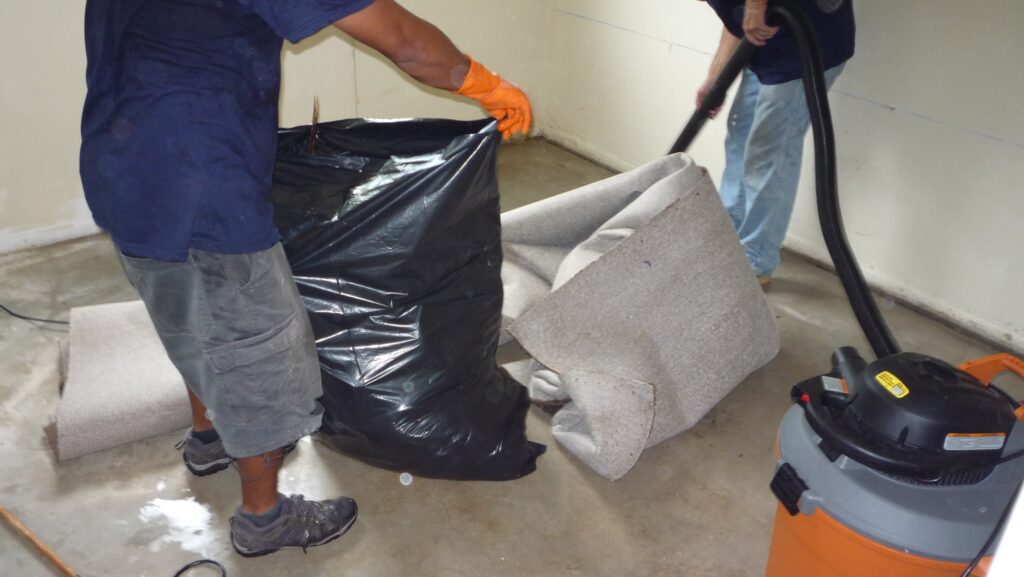
For limited clean water and where electrical safety is assured, a wet vacuum can remove some surface water. Large losses, water near electrical hazards and extensive hidden moisture are better handled with professional extraction equipment.
Does Wet Drywall Have to Be Removed?
Not always. Clean-water drywall can sometimes be dried in place when it remains sound and the wall assembly permits effective drying. Deterioration, insulation, contamination or trapped moisture can require removal.
Can the Wall Behind the Water Heater Be Dried?
Often, depending on construction and access. Moisture readings should determine whether drywall, framing and the sill plate can be dried in place or whether targeted access is needed.
Why Does the Sill Plate Matter?
The sill or sole plate can remain wet after drywall surfaces look improved. Measuring it helps determine whether the lower wall assembly is actually dry.
Can Water Get Under Tile or Other Flooring?
Yes. Water can move beneath floating floors, wood, carpet and some tile assemblies. The visible surface can look dry while moisture remains below.
Does Flooring Have to Be Removed?
Not automatically. Flooring type, installation, amount of trapped water, water source and ability to dry the substrate determine whether removal is necessary.
Can Cabinets Be Saved?
Sometimes. Construction, swelling, delamination, duration of wetting and access matter. The goal is to preserve cabinets that can appropriately be dried or restored.
Can Water Travel Under Kitchen or Bathroom Cabinets?
Yes. Water can migrate beneath toe kicks and cabinet bases, wetting wall plates, drywall and flooring without immediately becoming visible.
How Do You Find Hidden Water?
Restoration technicians use visual inspection, moisture meters, comparison readings and sometimes thermal imaging to map the moisture path. Thermal patterns guide investigation; moisture readings confirm material conditions.
How Do Air Movers and Dehumidifiers Work?
Wet moves toward dry. Dehumidifiers create a dry air environment, and air movers carry that dry air across wet surfaces to increase evaporation. The dehumidifier then removes the released moisture from the air.
How Long Does It Take to Dry a Water-Heater Loss?
Structural drying generally requires several days. Completion should be based on moisture readings and established dry standards, not simply a fixed number of days.
Should Drying Equipment Run Overnight?
Generally yes unless the restoration professional directs otherwise. Repeatedly turning equipment off can substantially extend drying time.
Should I Open Windows During Drying?
Usually not during controlled dehumidification in Southwest Florida. Humid outdoor air can work against the dry environment being created inside.
Could a Water-Heater Leak Cause Mold?
Possibly. A prompt clean-water response does not automatically become a mold project. Delayed discovery or materials left wet without effective drying increase the opportunity for microbial growth.
Do I Need Mold Testing After a Water-Heater Leak?
Not automatically. The immediate priorities are source control, extraction and drying. Mold assessment becomes more useful when discovery was delayed, visible growth or odor exists, or the extent is uncertain.
What Should I Ask a Water-Damage Company After a Water-Heater Loss in Lido Key?
Ask how quickly extraction can begin, how far the moisture path will be checked, whether drywall and flooring can be dried in place, whether cabinets or insulation are trapping moisture, how equipment will be sized, how daily moisture readings will be documented and what dry standard will determine completion.
Why Choose ServiceMaster SRQ After a Water-Heater Leak in Lido Key?
ServiceMaster SRQ provides professional water extraction and structural drying throughout Lido Key, Sarasota County, and surrounding Southwest Florida communities. We evaluate the entire moisture path instead of stopping when the visible water is gone. If a delayed loss has developed microbial contamination, we are also licensed to perform mold remediation.
Frequently Asked Questions About Water-Heater Flooding in Lido Key
Does the plumber dry my house too?
Usually not. The plumber repairs the source; the restoration company handles extraction and structural drying.
Does wet drywall always need removal?
No. Some clean-water drywall can be dried in place when conditions allow.
Could the leak cause mold?
Possibly, especially when discovery or drying is delayed, but a water-heater loss does not automatically mean mold.
Should I wait for insurance?
No. Document the loss and take reasonable action to prevent additional damage.
How do I know the structure is dry?
Use material-specific moisture readings and dry standards rather than appearance alone.
My Water Heater Flooded My Home on Lido Key, FL. What Do I Do Now?
Control the water and energy source when safe, photograph the damage and get extraction started quickly. ServiceMaster SRQ provides emergency water-damage restoration throughout Lido Key and Sarasota County. Call ServiceMaster SRQ so we can determine where the water traveled, remove it and begin drying the structure.