And it isn't:
"Put fans everywhere."
The objective is:
Control the loss. Determine what actually got wet. Save what can reasonably be saved. Remove what cannot be restored. Dry the remaining structure. Document the process.
What Is Water Damage Mitigation?
Water damage mitigation is the work performed to limit additional damage after a water loss and stabilize the affected property.
Imagine a supply line breaks behind a bathroom vanity.
A plumber may repair the failed pipe.
But the plumbing repair doesn't address water that has already traveled:
- Beneath the vanity
- Behind the baseboard
- Into drywall
- Under flooring
- Into an adjoining room
- Into insulation
- Through the floor into the ceiling below
That remaining water is the restoration problem.
The mitigation contractor determines where the water traveled and what must be done to prevent that moisture from causing additional damage.
This distinction is important:
Repairing the source stops new water from entering the building. Mitigation addresses the water that is already there.
Is Water Mitigation the Same as Water Damage Restoration?
The terms are often used interchangeably, but they can describe different phases of the overall restoration process.
Mitigation generally refers to the immediate work necessary to stabilize the property and prevent additional damage.
That can include:
- Extraction
- Moisture inspection
- Selective demolition
- Structural drying
- Cleaning
- Monitoring
Restoration can describe the broader process of returning the property to its pre-loss condition.
That may include both mitigation and subsequent repairs or reconstruction.
For example, if wet drywall must be removed during mitigation, replacing and painting that drywall would generally occur during reconstruction.
A simple way to understand it is:
Mitigation gets the building dry and stable. Reconstruction puts the damaged building materials back.
What Happens When a Water Damage Company First Arrives?
The first step should be evaluation, not automatically unloading equipment.
The restoration contractor needs to understand what happened.
That generally begins by determining:
- What caused the water loss?
- Has the source been stopped?
- When did the loss occur?
- Is water still entering the structure?
- Which rooms are visibly affected?
- Where could the water have traveled?
- Are there electrical or structural hazards?
- What types of materials are affected?
- Is contamination a concern?
- Has mechanical drying already been attempted?
- Is there evidence of a pre-existing moisture or mold condition?
This information helps determine the appropriate mitigation strategy.
Two houses can each have an inch of water on the floor and require completely different restoration procedures depending upon where the water came from, how long it was present, what materials became wet and where the water traveled.
Does It Matter Where the Water Came From?
Because not all water losses are treated the same way.
Water from a recently broken potable-water supply line presents different restoration considerations than water from:
- A toilet overflow
- Sewage
- A drain backup
- Groundwater
- Floodwater
- A roof leak
- A long-term plumbing leak
- Water that has passed through contaminated materials
The source, history and condition of the water can affect:
- What materials can be restored
- What materials should be removed
- Cleaning procedures
- Personal protective equipment
- Containment
- Air movement
- Disposal procedures
- Whether microbial contamination is already present
This is why a restoration contractor should understand the loss before simply setting equipment.
What Are Category 1, Category 2 and Category 3 Water?
Professional restoration terminology commonly classifies water according to its level of contamination.
A broken potable-water supply line may initially qualify as Category 1.
That does not mean Category 1 water remains sanitary forever.
The water can contact contaminants in the building, and conditions can deteriorate over time.
The exact restoration decisions depend on the source and circumstances of the loss.
Examples can include sewage and certain types of floodwater.
The important homeowner takeaway is:
The amount of water isn't the only thing that determines the restoration procedure. What is in the water matters too.
What Does "Class of Water Damage" Mean?
The class of a water loss generally describes the extent of water absorption and the amount of material affected, which helps restoration professionals evaluate the drying challenge.
This is different from water category.
An easy way to remember the distinction is:
A loss affecting a small amount of easily accessible material presents a different drying challenge from water that has extensively saturated drywall, wood, insulation and other porous materials throughout several rooms.
These classifications help inform the restoration plan, but professional judgment and actual site conditions still matter.
How Does a Restoration Company Determine What Got Wet?
This is one of the most important parts of professional mitigation.
The visible edge of the water is not necessarily the actual edge of the loss.
Restoration contractors may use:
- Visual inspection
- Moisture meters
- Thermal imaging where appropriate
- Psychrometric measurements
- Physical inspection
- Knowledge of building construction
- Moisture mapping
Water follows gravity, but it also travels through building materials and assemblies.
It can move:
- Under walls
- Through doorways
- Beneath flooring
- Behind cabinets
- Into drywall
- Through insulation
- Along framing
- Into adjacent rooms
- Between floors
That is why professional mitigation is not based solely on what looks wet.
The contractor needs to find the boundaries of the water loss.
What Is Moisture Mapping During Water Mitigation?
Moisture mapping means identifying and documenting the affected materials and areas.
The contractor establishes where elevated moisture is present and where normal or unaffected conditions begin.
That information can then be compared during subsequent visits.
For example:
Day 1: A section of drywall shows elevated moisture.
Day 2: The moisture level has decreased.
Day 3: The material has reached the established drying goal.
That is much more useful than saying:
"We ran the fans for three days."
Drying time by itself does not prove that a building is dry.
Measurements do.
Does Thermal Imaging Show Water Inside Walls?
Not directly.
This is a common misconception.
A thermal imaging camera detects surface-temperature differences.
Moisture can create temperature patterns that help a trained restoration professional identify areas requiring further investigation.
But the camera is not taking an X-ray of water behind the wall.
A suspicious thermal pattern should generally be confirmed using appropriate moisture-detection methods.
Thermal imaging is an excellent investigative tool.
It is not a replacement for a moisture meter or professional judgment.
Why Is Water Extraction So Important?
Because physically removing liquid water is generally much faster than trying to evaporate all of it.
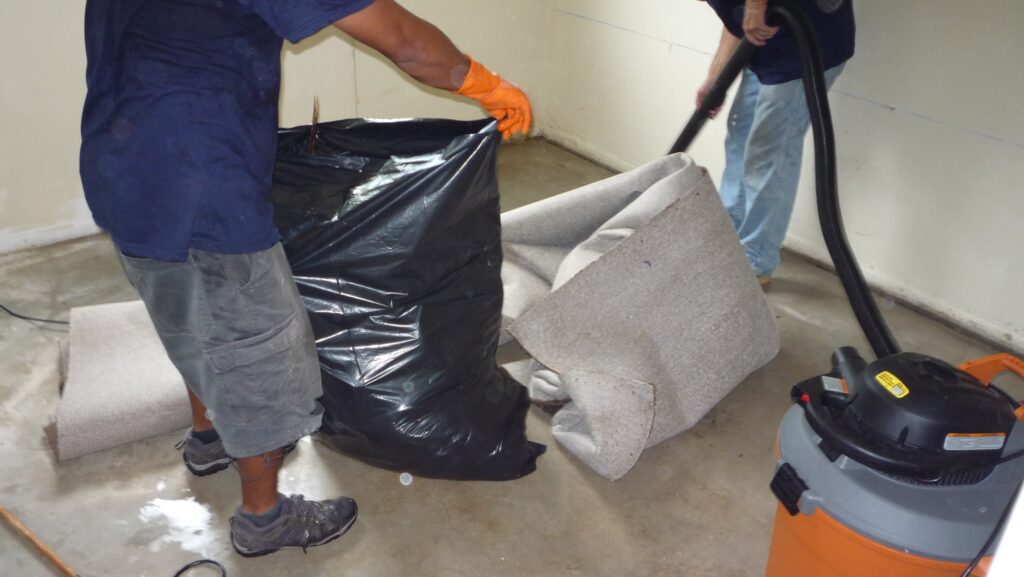
If there is standing water or significant water held in carpet and other accessible materials, extraction can remove a substantial amount of moisture before mechanical drying begins.
Depending upon the loss, extraction equipment may be used on:
- Hard surfaces
- Carpet
- Carpet pad
- Flooring systems
- Other accessible materials
The more liquid water that can appropriately be removed through extraction, the less moisture the drying system has to remove through evaporation and dehumidification.
Extraction removes bulk water. Mechanical drying removes the moisture that remains.
Does Wet Carpet Always Have to Be Removed?
No.
The answer depends heavily on:
- Water category
- Length of exposure
- Carpet condition
- Pad condition
- Installation
- Contamination
- Whether effective extraction and drying can be performed
Carpet affected by a recent sanitary water loss may sometimes be extracted, cleaned and dried.
Other conditions may require removal.
The carpet pad also has to be evaluated separately.
The correct decision should be based on the actual loss conditions, not a universal rule that all wet carpet stays or all wet carpet goes.
Why Do Restoration Companies Move Furniture and Contents?
Because contents can interfere with inspection, extraction and drying.
Furniture sitting on wet carpet or flooring can also suffer additional damage and may prevent the surface underneath from drying properly.
Depending upon the loss, contents may be:
- Moved within the room
- Blocked or elevated
- Relocated to an unaffected area
- Packed out when necessary
- Documented if damaged
The objective is to provide access to affected building materials while protecting contents from additional damage.
Does Water Mitigation Always Mean Tearing Out Drywall?
No.
Professional mitigation should not be demolition for the sake of demolition.
Some wet materials can be dried successfully in place.
Others cannot.
Drywall removal may be appropriate when:
- The material has physically deteriorated
- Contamination requires removal
- Wet insulation is trapped behind it
- Effective drying cannot otherwise be established
- Moisture has remained uncontrolled for an extended period
- Microbial growth is present
- Access to another affected assembly is necessary
But drywall that can be safely and effectively dried does not necessarily need to be removed simply because a moisture meter shows that it is wet.
The objective should be:
Remove what needs to be removed. Save what can reasonably be saved.
Why Would Baseboards Be Removed After Water Damage?
Baseboards can conceal wet drywall and wall cavities.
They can also restrict evaporation from the lower portion of a wall.
Removing baseboard may allow the restoration contractor to:
- Inspect the bottom of the wall
- Evaluate drywall
- Check wall cavities
- Access wet materials
- Improve drying
- Create drying openings when appropriate
But again, removal should have a purpose.
Not every baseboard in every wet room automatically needs to come off.
What Is Selective Demolition?
Selective demolition means removing only the building materials necessary to properly mitigate the loss rather than indiscriminately gutting the affected area.
Examples might include:
- Removing damaged baseboard
- Cutting a limited section of drywall
- Removing wet insulation
- Removing unsalvageable flooring
- Opening a wall cavity
- Removing damaged cabinet components
The purpose is to gain access, remove materials that cannot be restored and allow the remaining structure to dry.
Good mitigation balances two objectives:
Prevent additional damage while avoiding unnecessary damage caused by the restoration itself.
Can Cabinets Be Saved After Water Damage?
Sometimes.
Cabinet restoration depends on:
- Cabinet construction
- Material
- Water source
- Degree of saturation
- Duration
- Swelling or delamination
- Whether water is trapped underneath or behind the cabinet
- Ability to create effective drying access
Solid wood, plywood, MDF, particleboard and other cabinet materials react very differently to water.
Sometimes toe kicks or other limited components can be removed to provide drying access without removing an entire cabinet run.
Other times the cabinet material has swollen or deteriorated beyond practical restoration.
The decision should be made from the actual construction and condition of the cabinet, not simply because it became wet.
What Happens After the Standing Water Is Removed?
Once bulk water has been extracted and necessary material decisions have been made, the focus shifts to structural drying.
This is where professional mechanical drying begins.
The contractor establishes drying conditions using equipment such as:
- Air movers
- Dehumidifiers
- Specialized drying systems when necessary
The goal is to create an environment that encourages moisture to leave wet building materials.
The basic principle is:
Wet moves toward dry.
A professional mechanical drying system intentionally creates a dry environment around wet building materials.
Why Are Both Dehumidifiers and Air Movers Needed?
Because they perform different parts of the drying process.
Dehumidifiers create and maintain the dry air pocket.
As water evaporates from drywall, wood and other materials, the moisture enters the surrounding air as water vapor.
The dehumidifier removes that water vapor and returns drier air to the environment.
Air movers move that dry air across wet surfaces.
Moving dry air across the surface helps moisture evaporate from the material.
The cycle looks like this:
Wet material -> dry air moves across the surface -> moisture evaporates -> dehumidifier removes moisture from the air -> dry air returns to the environment -> drying continues.
Without adequate dehumidification, air movers can evaporate moisture into the room faster than the environment can effectively manage it.
Without appropriate air movement, the dry air may not interact efficiently with wet surfaces.
The equipment works as a system.
How Quickly Should Water Damage Be Addressed?
Why Doesn't a Restoration Company Just Put a Fan in the Room?
Because a fan alone does not create a controlled mechanical drying environment.
A household fan may move air.
But professional structural drying involves managing:
- Moisture in the materials
- Moisture in the air
- Temperature
- Air movement
- Dehumidification
- Drying progress
If moisture evaporates from building materials but remains in the indoor air, relative humidity can increase and drying can become less efficient.
The objective is not merely:
Make air move.
It is:
Create conditions that continually move moisture out of the wet materials and remove that moisture from the drying environment.
How Does a Restoration Company Know How Much Equipment to Use?
Equipment should be based on the actual drying conditions and affected materials, not simply on how many rooms have water damage.
Professional equipment calculations and placement consider factors such as:
- Amount of affected material
- Surface area
- Water class
- Material porosity
- Amount of evaporation expected
- Dehumidification capacity
- Room configuration
- Temperature
- Relative humidity
- Drying progress
More equipment does not automatically mean faster or better drying.
Too little equipment can slow the process.
Equipment should be properly selected, placed and adjusted as the structure dries.
What Are Psychrometric Readings?
Psychrometry deals with the relationship between air, temperature and moisture.
Restoration professionals take environmental readings to understand the conditions inside and outside the drying area.
Depending upon the equipment and drying plan, those readings can include:
- Temperature
- Relative humidity
- Other calculated moisture relationships used in structural drying
These measurements help determine whether the drying environment is improving and whether the equipment is performing as intended.
The important homeowner takeaway is:
Professional drying should be measured, not guessed.
Does the Restoration Company Need to Come Back Every Day?
Professional water mitigation normally requires ongoing monitoring, although the exact schedule depends on the loss.
The contractor needs to determine whether:
- Materials are drying
- Environmental conditions are improving
- Equipment is operating properly
- Equipment placement needs adjustment
- Additional material needs to be exposed
- Equipment can be reduced
- Drying goals have been achieved
Leaving equipment in a building for several days without evaluating the drying progress misses one of the most important parts of structural drying.
Equipment doesn't monitor the job. People do.
Why Does the Restoration Company Move the Equipment Around?
Because the drying conditions change.
An area that was extremely wet on Day 1 may be substantially drier on Day 2.
Another material may require additional airflow.
A dehumidifier may no longer be needed in one drying chamber but still be necessary elsewhere.
Professional drying is dynamic.
Equipment should be adjusted based on what the measurements show, not left in exactly the same position simply because that is where it was originally installed.
How Long Does Professional Water Mitigation Take?
There is no universal answer.
The mitigation phase depends on:
- Amount of water
- Materials affected
- Water category
- Water class
- How long the structure remained wet
- Building construction
- Temperature and humidity
- Accessibility
- Equipment
- Whether materials can be dried in place
- Whether demolition is required
- How the materials respond to drying
Some losses dry relatively quickly.
Others take longer.
A three-day equipment rental is not a scientific drying standard.
The building is dry when the affected materials reach appropriate drying goals-not when the calendar says the drying period should be over.
How Does the Restoration Company Know When the Building Is Dry?
By measuring it.
The contractor should compare moisture conditions during the job against appropriate drying goals and unaffected or normal conditions where applicable.
The final decision should not be based solely on:
- Touch
- Appearance
- Smell
- Number of drying days
- Whether the homeowner thinks it feels dry
A wall can feel dry and still contain elevated moisture.
A floor can look dry while moisture remains beneath it.
Drying completion should be supported by measurements.
What Documentation Should a Water Mitigation Company Provide?
Documentation is an important part of professional restoration.
Depending upon the loss, documentation may include:
- Photographs
- Source information
- Affected-area documentation
- Moisture readings
- Moisture maps
- Equipment records
- Drying logs
- Temperature and humidity readings
- Material-removal documentation
- Work performed
- Contents manipulation
- Final drying conditions
- Invoices and supporting records
Good documentation serves several purposes.
It helps explain:
What happened.
What was affected.
Why the work was necessary.
What the restoration contractor did.
Whether the structure dried.
This is valuable to the homeowner regardless of whether an insurance claim is involved.
Should I Take My Own Photos Before Water Mitigation Starts?
Yes, when it is safe and practical.
Before the condition changes, photograph or video:
- The source
- Standing water
- Affected rooms
- Flooring
- Walls
- Ceilings
- Cabinets
- Baseboards
- Damaged contents
- Water migration
- Any visible plumbing failure
Do not delay necessary emergency work simply to document every square inch of the house.
But when practical:
Document before you disturb.
And continue documenting significant changes during mitigation.
Should I Wait for the Insurance Adjuster Before Water Mitigation Begins?
Generally, you should not allow avoidable damage to continue simply because you are waiting for an insurance inspection.
Read your policy and follow its reporting requirements.
Many homeowners policies contain duties after a loss requiring the policyholder to take reasonable steps to protect the property from additional damage.
That may include:
- Stopping the source when safely possible
- Extracting standing water
- Beginning necessary drying
- Protecting contents
- Preventing water from spreading
- Documenting the condition
- Preserving relevant damaged materials when appropriate
- Keeping invoices and records
The restoration contractor handles the mitigation.
The insurance carrier determines coverage under the policy.
Those are separate issues.
Report the loss as required, document it and take reasonable action to prevent additional damage.
Does the Insurance Company Choose My Restoration Contractor?
Homeowners frequently receive recommendations for restoration companies from insurance carriers, agents, plumbers, property managers or other parties.
But the restoration company is entering the homeowner's property and performing work on the homeowner's building.
Before authorizing work, understand:
- Who hired the contractor
- What work is being authorized
- How the contractor will document the loss
- How charges will be calculated
- What the contractor expects from the homeowner
- What happens if insurance does not pay the entire invoice
Insurance coverage and contractor authorization are related issues, but they are not the same thing.
A restoration contractor cannot guarantee what an insurance carrier will cover.
Does Water Mitigation Include Reconstruction?
Not necessarily.
Mitigation and reconstruction are different phases.
Mitigation may leave the property:
- Dry
- Clean
- Stable
- Partially demolished
If drywall, flooring, cabinets, trim or other building materials were removed, reconstruction may then be necessary.
That can include:
- Drywall replacement
- Texture
- Painting
- Flooring
- Baseboard
- Cabinet work
- Carpentry
- Other repairs
Some restoration companies provide both mitigation and reconstruction.
Others perform mitigation and leave reconstruction to another contractor.
The homeowner should understand where the mitigation scope ends and the repair scope begins.
What Should My House Look Like When Mitigation Is Finished?
That depends on the severity of the loss.
A successful mitigation project does not necessarily mean the property looks completely restored.
It means the water-damage problem has been stabilized and appropriately dried.
If no demolition was necessary, the property may look nearly unchanged.
If damaged materials had to be removed, the property may have:
- Missing drywall
- Removed baseboards
- Exposed framing
- Removed flooring
- Open cabinet areas
- Other controlled demolition
That does not mean mitigation is incomplete.
It means the property is ready for the repair or reconstruction phase.
What Are Signs of a Poor Water Mitigation Job?
Homeowners should ask questions when:
- No one checks beyond the visibly wet area
- Moisture meters are not used
- Equipment is installed without meaningful inspection
- No one returns to monitor drying
- Materials are demolished without explanation
- Obviously wet concealed areas are ignored
- Equipment is removed based only on a predetermined number of days
- No drying documentation is maintained
- The contractor cannot explain what is wet
- The contractor cannot explain why something needs removal
- The contractor cannot explain how it knows the structure is dry
Professional restoration involves equipment.
But equipment alone does not make the work professional.
Inspection, judgment, measurements, documentation and verification are what turn equipment into a drying system.
What Should I Ask a Water Damage Restoration Company?
Useful questions include:
- How are you determining what got wet?
- Are you checking behind walls and beneath flooring where appropriate?
- What moisture-detection equipment are you using?
- What materials do you believe can be saved?
- Why are you recommending removal of this material?
- How will you monitor drying?
- How often will you return?
- What documentation will I receive?
- How will you determine when the structure is dry?
- Do you follow recognized water-restoration standards?
- Who handles reconstruction after mitigation?
A competent restoration contractor should be able to explain the process in language you understand.
You should not have to become a restoration technician.
But you should understand what is being done to your house and why.
What Professional Standard Applies to Water Damage Mitigation?
The primary recognized professional standard for water-damage restoration is the ANSI/IICRC S500 Standard for Professional Water Damage Restoration.
The S500 addresses subjects including:
- Principles of water restoration
- Microbiology of water damage
- Health and safety
- Building and material science
- Psychrometry
- Drying technology
- Equipment
- Inspections
- Documentation
- Structural restoration
A standard does not eliminate the need for professional judgment.
Every building and every water loss is different.
But recognized standards provide a framework for evaluating and performing professional restoration work.
What Happens During Water Damage Mitigation From Start to Finish?
Although every project is different, the process generally looks something like this:
- Stop the Source
The active water source is controlled or repaired.
- Inspect the Loss
The contractor determines what happened, what areas may be affected and what hazards or contamination concerns exist.
- Find the Water
Moisture-detection equipment and physical inspection are used to determine how far the water traveled.
- Document the Condition
Photographs, moisture readings and other documentation establish the initial condition of the property.
- Extract Water
Standing and accessible bulk water is physically removed.
- Evaluate Materials
The contractor determines which materials can reasonably be restored and which require removal.
- Perform Necessary Selective Demolition
Materials that cannot be restored or that prevent effective drying are removed as necessary.
- Establish Mechanical Drying
Air movers, dehumidifiers and other appropriate drying equipment are installed.
- Monitor the Structure
Environmental conditions and material moisture are measured throughout the drying process.
- Adjust the Drying System
Equipment is moved, reduced or modified as drying progresses.
- Confirm Drying Goals
The contractor verifies that affected materials have reached appropriate drying conditions.
- Remove Equipment
Drying equipment is removed after the drying goals have been achieved.
- Prepare for Reconstruction
If materials were removed, the property moves into the repair or reconstruction phase.
That entire process can be summarized in one sentence:
Stop the water -> find the water -> remove the excess -> save what can be saved -> remove what cannot -> create a dry environment -> monitor the drying -> verify the structure is dry.
Key Takeaways
- Water mitigation addresses the water already inside a building after the source is stopped.
- A plumber repairs the plumbing failure; a restoration contractor addresses the resulting water damage.
- Professional mitigation should begin with inspection, not simply equipment placement.
- The source and contamination level of the water affect restoration decisions.
- Water category and water class describe different aspects of a loss.
- Visible water does not necessarily show the complete affected area.
- Moisture mapping helps establish the actual boundaries of the loss.
- Thermal imaging can identify suspicious temperature patterns but does not directly see water.
- Extraction removes bulk liquid water before structural drying.
- Wet drywall, carpet, cabinets and other materials do not automatically require removal.
- Selective demolition should have a specific restoration purpose.
- The goal is to save what can reasonably be saved while removing materials that cannot be properly restored.
- Mechanical drying creates a dry environment around wet materials.
- Wet moves toward dry.
- Dehumidifiers maintain the dry air pocket while air movers move dry air across wet surfaces.
- Equipment should be selected and adjusted according to actual drying conditions.
- More fans do not automatically mean better drying.
- Professional drying requires ongoing monitoring.
- The number of days equipment has been running does not determine whether the structure is dry.
- Drying completion should be supported by moisture measurements.
- Documentation is an important part of professional water mitigation.
- Homeowners should document the loss when safe and practical.
- Necessary emergency mitigation should not be unnecessarily delayed while waiting for an insurance inspection.
- Mitigation and insurance coverage determinations are separate issues.
- Mitigation and reconstruction are different phases of restoration.
- A properly mitigated property may still require repairs after it is dry.
- The ANSI/IICRC S500 provides the primary professional framework for water-damage restoration.
Frequently Asked Questions
What does a water mitigation company do?
A water mitigation company determines where water traveled, extracts excess water, evaluates affected materials, performs necessary selective demolition, establishes mechanical drying, monitors moisture and verifies that appropriate drying goals have been achieved.
Is water mitigation just water extraction?
No. Extraction is only one part of mitigation. Water may remain inside drywall, flooring, wood and concealed building assemblies after standing water has been removed.
How quickly should water mitigation begin?
As quickly as reasonably possible after the source is controlled and the area is safe. Prompt mitigation improves the opportunity to limit secondary damage and save affected materials.
Does everything that gets wet need to be removed?
No. Some materials can be successfully dried and restored. Removal decisions should consider the water source, material, contamination, physical damage, accessibility and ability to achieve effective drying.
Why do restoration companies cut drywall?
Drywall may be removed because it is damaged or contaminated, because wet insulation is trapped behind it, or because access is necessary to dry a concealed wall assembly. It should not be removed without a restoration reason.
Why are holes sometimes drilled behind the baseboard?
Small openings may sometimes be used to introduce airflow into a wall cavity or provide drying access while minimizing unnecessary demolition. Whether that approach is appropriate depends on the wall construction and conditions of the loss.
How long do dehumidifiers need to run after water damage?
There is no universal number of days. Equipment should remain until appropriate drying goals are achieved, with moisture conditions monitored during the process.
Why does the restoration company keep checking the walls?
Because drying progress needs to be measured. Repeated moisture readings help determine whether materials are drying and when appropriate drying goals have been reached.
Can water damage dry without removing drywall?
Sometimes. Drywall can often be dried in place under appropriate conditions when the water source, material condition and wall assembly allow effective drying.
Can cabinets be dried instead of removed?
Sometimes. Cabinet construction, material, saturation, contamination and access determine whether drying is practical.
Should I wait for insurance approval before mitigation?
Read your policy and follow its reporting requirements, but do not unnecessarily allow preventable additional damage to occur while waiting for an inspection. Take reasonable emergency measures, document the loss and keep records of the work.
Does homeowners insurance always pay for water mitigation?
No restoration contractor can guarantee coverage. Coverage depends on the policy, cause of loss, exclusions, conditions and the insurance carrier's claim determination.
How do I know if the restoration company actually dried my house?
Ask how drying was monitored and what measurements were used to establish completion. Professional drying should be supported by moisture measurements rather than appearance or an arbitrary number of days.
What happens after water mitigation is finished?
If materials were removed, reconstruction may begin. This can include drywall, flooring, trim, cabinets, painting and other repairs necessary to return the property to its pre-loss condition.
What is the difference between mitigation and reconstruction?
Mitigation stops additional damage and gets the structure dry and stable. Reconstruction replaces or repairs building materials damaged by the loss or removed during mitigation.
Have Water Damage in Sarasota or Bradenton?
When water enters a building, the most important question isn't simply:
"How do we get the water off the floor?"
It is:
"Where did the water go, what did it affect, and what needs to happen to get the structure dry?"
ServiceMaster SRQ provides professional water-damage mitigation and structural drying throughout Sarasota, Bradenton and surrounding Southwest Florida communities.
Our mitigation process is designed to identify the affected areas, extract excess water, evaluate hidden moisture, preserve materials that can reasonably be saved, remove materials when necessary, establish professional mechanical drying conditions, monitor drying progress and document the work through completion.
We don't determine that a building is dry simply because the equipment has been running for a predetermined number of days.
We measure the structure and follow the drying process to completion.
If you've discovered water damage, take photographs when it is safe to do so, stop the source if you safely can, and don't assume the damage ends where the visible water stops.
Contact ServiceMaster SRQ for water extraction, moisture inspection, water-damage mitigation and professional structural drying in Sarasota, Bradenton and surrounding areas.