
Kitchen Sink Mold Remediation, Cabinet Repair, and Post-Remediation Testing – Sarasota, FL
Kitchen Sink Mold Remediation, Cabinet Repair, and Post-Remediation Testing – Sarasota, FL
Kitchen sink cabinet
Project Quick Facts
Location
Sarasota, Florida
Service
Containment, targeted removal, environmental cleaning, cabinet-base reconstruction, preservation of unaffected cabinetry, and post-remediation testing
Property
Home
Cause
Sink plumbing
Equipment
Air Scrubbers
PRV
Post Remediation Testing passed
Short Answer
Yes. Mold beneath a kitchen sink does not necessarily mean the entire cabinet or kitchen must be removed.
When contamination is limited to specific materials and unaffected portions can be adequately protected and cleaned, targeted remediation may allow much of the existing cabinetry to remain. In this Sarasota project, affected materials were remediated, the damaged cabinet base was reconstructed, and post-remediation testing was performed following the environmental work.
Inspection & Findings
Inspection & Findings
The initial evaluation identified mold-related conditions associated with the kitchen sink cabinet area.
The contamination appeared sufficiently localized to allow a targeted remediation approach rather than removal of the entire cabinet system. This distinction was important because much of the surrounding cabinetry remained serviceable and could be preserved.
The affected cabinet base and materials beneath or immediately surrounding the sink required remediation and repair. The scope therefore needed to accomplish two separate objectives: properly address the mold-related conditions and preserve unaffected components wherever practical.
The project also required planning for reconstruction from the beginning. Removing contaminated portions of cabinetry without considering how the cabinet would subsequently be rebuilt can create unnecessary damage and expense.
A selective remediation and reconstruction strategy was therefore developed around the actual conditions identified during inspection.
Containment and Work-Area Preparation
Containment was established around the affected kitchen area before remediation activities proceeded.
The purpose of containment during mold remediation is to separate the work area from unaffected portions of the residence and help control the movement of dust and particulate generated during removal and cleaning.
Because this project involved an existing finished kitchen, protection of surrounding surfaces and cabinetry was particularly important.
The work area was prepared so technicians could access the affected materials while limiting unnecessary disturbance to the remainder of the kitchen.
Selective Removal of Affected Materials
Mold remediation does not automatically require removing every material near the affected area.
Materials are evaluated according to their condition, composition, extent of contamination, and whether they can be effectively cleaned.
For this project, removal was concentrated on materials that required replacement while serviceable portions of the cabinetry were preserved.
This selective approach reduced unnecessary demolition and allowed the existing kitchen configuration to remain largely intact.
Detailed Environmental Cleaning
Following removal of affected materials, exposed areas were professionally cleaned as part of the remediation process.
Detailed cleaning is an important component of mold remediation because removal alone does not address particulate that may remain on surrounding surfaces.
Accessible surfaces within the remediation area were cleaned as appropriate to the materials and conditions encountered.
Once environmental cleaning was completed, the work area could proceed toward verification and reconstruction.
Cabinet Base Reconstruction
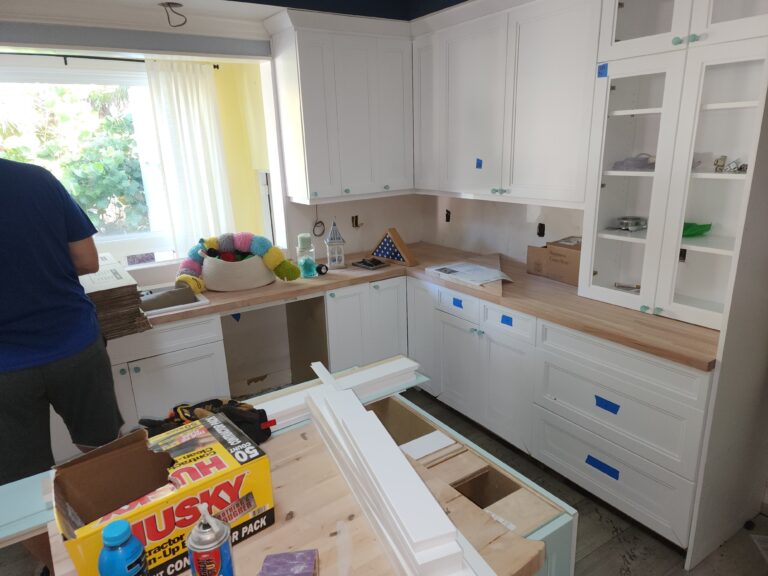
One of the more important aspects of this project was restoring the existing cabinetry rather than replacing the entire cabinet assembly.
After remediation, the damaged portion of the sink cabinet was reconstructed so the cabinet could again function as intended.
The project photograph shows the kitchen during the reconstruction phase, with the majority of the existing cabinetry preserved while repair work was concentrated in the affected sink area.
This type of selective reconstruction can substantially reduce disruption when the damage is localized and the remaining cabinetry is in serviceable condition.
Post-Remediation Testing
Post-remediation testing was conducted following completion of the remediation activities.
Post-remediation evaluation provides an additional step between environmental remediation and final completion of the project. Its purpose is to evaluate conditions after remediation rather than relying solely on visual appearance.
This distinction matters because an area looking clean does not, by itself, establish the results of environmental remediation.
Testing following remediation provided additional information about conditions within the treated area before the project was considered complete.
Why the Entire Kitchen Didn't Need to Be Removed
One of the most common concerns homeowners have when mold is discovered inside cabinetry is that an entire kitchen will need to be demolished.
That is not necessarily the case.
The appropriate scope depends upon where the contamination is located, which materials are affected, whether affected materials can be effectively cleaned, and whether surrounding components can remain without compromising the remediation.
In this project, the conditions allowed the work to remain localized.
By combining targeted remediation with selective reconstruction, the affected cabinet area could be addressed without unnecessarily sacrificing the surrounding cabinetry.
Restoration Timeline
Restoration Timeline
1. Inspection & Findings
The kitchen sink area was evaluated and mold-related conditions were identified within the affected cabinet area.
2. Scope Development
The affected materials were identified and a targeted remediation strategy was developed to preserve unaffected kitchen components wherever practical.
3. Containment
The work area was isolated to help control dust and particulate generated during remediation activities.
4. Selective Remediation
Affected materials requiring removal were addressed while serviceable portions of the cabinetry were retained.
5. Environmental Cleaning
Exposed surfaces within the remediation area were thoroughly cleaned and treated as appropriate.
6. Post-Remediation Testing
Testing was performed following remediation to evaluate conditions within the treated area.
7. Cabinet Reconstruction
The damaged cabinet base was rebuilt to restore the existing sink cabinet and complete the restoration process.
Scope Highlights
- Kitchen sink mold remediation
- Inspection of affected cabinet area
- Targeted containment
- Selective removal of affected materials
- Detailed environmental cleaning
- Treatment of affected areas
- Preservation of unaffected cabinetry
- Post-remediation testing
- Cabinet-base reconstruction
- Restoration of existing kitchen components
- Coordinated remediation and reconstruction services
Equipment Deployed
Project Gallery
Frequently Asked Questions
Frequently Asked Questions
Does mold underneath a kitchen sink mean the entire cabinet must be replaced?
Not necessarily. If contamination and material damage are localized, affected portions may sometimes be removed and reconstructed while serviceable cabinet components remain.
What commonly causes mold beneath kitchen sinks?
Plumbing leaks, drain leaks, supply-line failures, condensation, previous water damage, and repeated minor moisture exposure can all contribute to conditions that support mold growth.
Why is containment used for a relatively small mold area?
Containment helps separate remediation activities from unaffected portions of the residence and control particulate generated during removal and cleaning.
Can mold be cleaned from cabinetry?
It depends on the material and its condition. Some surfaces may be effectively cleaned, while deteriorated or heavily affected porous materials may require removal.
Why perform post-remediation testing?
Post-remediation testing provides additional information about conditions after remediation has been completed and can help evaluate whether the treated area is ready to proceed to the next phase of restoration.
Can damaged cabinets be repaired after mold remediation?
Often, yes. When damage is limited to portions of a cabinet, selective reconstruction may restore the affected components without requiring replacement of the entire cabinet system.
Should reconstruction begin immediately after mold removal?
Environmental remediation should be completed and the affected area appropriately evaluated before permanent reconstruction closes the area back in.
Need Mold Remediation in Sarasota?
Mold beneath a sink, vanity, cabinet, or other concealed area does not necessarily mean extensive demolition is required.
ServiceMaster SRQ provides professional mold remediation and restoration services throughout Sarasota, Bradenton, Lakewood Ranch, Siesta Key, Longboat Key, and surrounding Gulf Coast communities.
Call ServiceMaster SRQ at 941-377-2455 to schedule an evaluation.
"Key Takeaway Localized mold does not automatically require widespread demolition. The goal of professional remediation is to identify what is actually affected and develop an appropriate scope around those conditions. In this Sarasota kitchen, that meant isolating the affected area, addressing contaminated materials, thoroughly cleaning the remediation area, verifying conditions following remediation, and rebuilding the damaged portion of the cabinet. The result was a more focused restoration approach that addressed the environmental concern while preserving unaffected portions of the existing kitchen."
Have a similar issue?
ServiceMaster SRQ provides 24/7 emergency water damage restoration, mold remediation, fire damage cleanup, demolition, and specialty cleaning throughout Sarasota and Manatee Counties. Contact us today to schedule an inspection or request emergency service.
Call 941-377-2455 NowRelated Case Studies


More Case Studies
Whole-Home Remodel Dust and Surface Mold Cleaning After Tile Installation – Vina Del Mar Island, St. Pete Beach, FL 33706
View Project →How Quickly Should Water Damage Be Addressed to Prevent Mold? A Sarasota, Florida Case Study
View Project →